
When the Rose-Colored Glasses Begin to Fade

When you remove the rose-colored glasses…
Or should say, when you do more than just remove the glasses, when you begin to peel away the stained glaze that has settled over your vision, layer by layer, until you can finally see what has been there all along.
You begin to realize that the picture you have been painting and looking at isn't exactly the picture that exists. It's the picture you created. A picture you created with your hopes, your expectations, your experiences, your fears, and your need to believe that what you were holding onto was real.
You begin to see people not just for who you hoped they would be, but for who they consistently show you they are. You begin to recognize situations not for their potential, but for their reality. And honestly, maybe the hardest part is realizing that what you believed to be true was, partly, something you had constructed in your own mind.
Then the question is why?
Why do we paint these pictures in the first place?
Maybe, it's because we want to believe in the good. MAybe, it's because we see potential in people that they have not yet learned to embody themselves. Maybe, it's because we are trying to make sense of something that doesn't make sense, or because accepting the truth would mean facing a change we aren't ready to make.
And sometimes... maybe.. we paint the picture because we need it to be true.
We need the relationship to be what we imagined it could be. We need the situation or job to work out because we have invested so much of ourselves into making it work. We need to believe that if we just try a little harder, give a little more, love a little deeper, or become a little more accommodating, eventually everything will fall into place.
So we keep painting... switching mediums... try glaze... stain... this... that....
We add another layer of understanding. Another layer of patience. Another layer of compromise. We explain away the things that hurt us, downplay the things that disappoint us, and convince ourselves that the pieces that don't fit are simply temporary imperfections in an otherwise beautiful picture.
We call it hope. We call it loyalty. We call it love. Sometimes, we even call it commitment.
But beneath all of it, there may be something else.
A desire to feel safe. To feel chosen. To feel secure. To prove that we are worthy of the love, the connection, the belonging, or the life we have been working so hard to hold onto.
And without even realizing it, we begin to abandon the very person we were trying to protect.
WE COMPROMISE OUR TRUTH TO PRESERVE AN ILLUSION OF SAFTY
We silence the voice inside that whispers something isn't right. We dismiss the discomfort in our bodies. We ignore the exhaustion that comes from constantly trying to make something fit. We become so focused on maintaining the picture that we stop asking ourselves whether we even want to be standing inside it anymore.
And that is where the deeper awakening begins.
Because eventually, the layers start to peel away... the corners lift... and we see somethings underneath.
Maybe it's a moment of clarity. Maybe it's a series of disappointments. Maybe it's the quiet exhaustion of realizing that you have been pouring so much of yourself into something that gives so little of you back.
Or maybe nothing dramatic happens at all.
Maybe one day, you simply look at your life and realize that the things you once worked so hard to hold onto no longer feel like home.
The people you once tried so hard to understand no longer feel aligned with who you really are. The roles you once accepted no longer feel authentic. The compromises you once justified begin to feel like parts of yourself that you can no longer afford to give away.
And the hardest truth?
Maybe the picture wasn't entirely wrong. Maybe there were beautiful moments, genuine connections, and things worth loving. Perhaps what you saw was real in some ways.
But potential is not the same as reality. A beautiful moment is not the same as a consistent pattern. And loving what something could be does not mean you are required to remain in what it actually is.
Sometimes, the illusion isn't that everything was false. It's that we believed the beautiful parts were enough to make the parts that hurt us acceptable.
And when we finally see that distinction, we are faced with a choice.
Do we continue to repaint the picture, hoping it will eventually resemble what we need? Or do we allow ourselves to see it clearly, even if the truth asks us to release something we have spent years trying to preserve?
This is where we must learn to sit with the discomfort of reality without immediately trying to change it into something easier to accept.
We must learn that disappointment does not always mean we failed. That letting go does not erase what something meant to us. That outgrowing a person, a belief, or a version of our lives does not make the past meaningless.
And most importantly, we must learn that we do not have to keep sacrificing ourselves to prove that something is worth saving.
Because what is the cost of preserving an illusion if the price is your own essence?
What does it matter if the picture looks beautiful from the outside if you no longer recognize yourself within it?
How much of your life are you willing to spend trying to make something feel right when, deep down, you know it no longer is?
These are not easy questions. They ask us to look beyond the surface and take an honest look at our own participation in the stories we tell ourselves.
Not to blame ourselves for what we couldn't see, but to understand why we needed to see it that way.
There is compassion in that understanding.
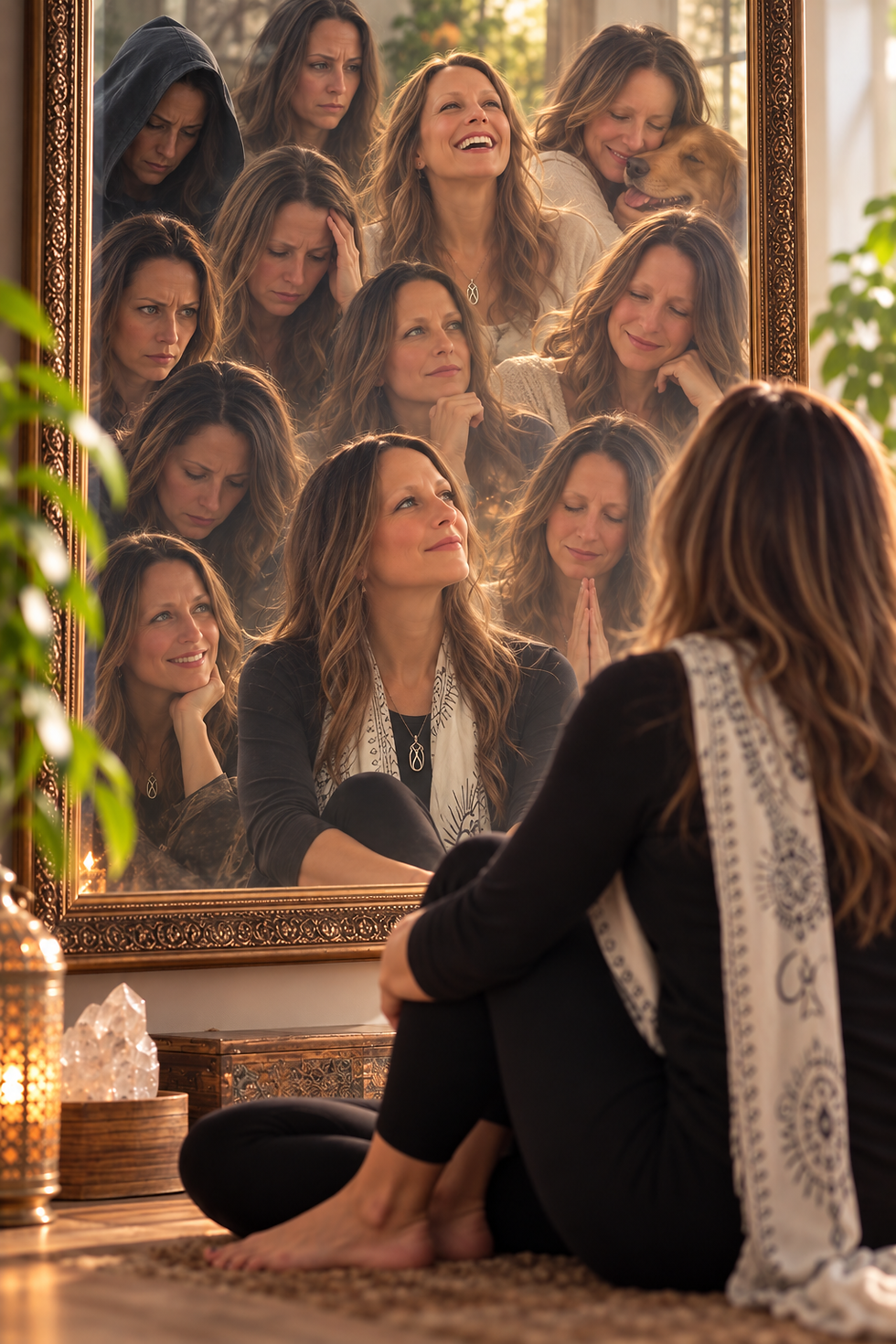
We can acknowledge that the version of ourselves who painted that picture was doing the best she could with what she knew, what she felt, and what she needed at the time. She was trying to create security. She was trying to protect her heart. She was trying to make something meaningful out of the circumstances she was given.
We don't have to shame her for that.
But we also don't have to let her keep painting.
We can thank her for getting us here and give ourselves permission to see differently now.
Because perhaps the real transformation isn't simply about removing the rose-colored glasses. It's about learning to recognize the lens through which we have been viewing our lives in the first place.
It's about understanding where our perceptions end and our projections begin. Where love ends and self-abandonment begins. Where patience becomes avoidance. Where hope becomes an attachment to potential. Where keeping the peace means sacrificing our own.
And once we begin to see those distinctions, something shifts.
We stop asking, "How can I make this work?"
And we begin asking, "Does this truly work for me?"
We stop asking, "How can I become what this situation needs me to be?*
And we begin asking, *Who am I when I no longer have to contort myself to belong here?"
We stop measuring our worth by what we can endure, how much we can give, or how long we can hold on.
And we begin to understand that our worth was never dependent on our ability to make an imperfect picture look whole.
Maybe this is what it means to return to ourselves.
Not to become someone new, but to stop abandoning who we have always been beneath the layers of expectation, fear, conditioning, and the stories we created to feel safe.
To choose truth over familiarity. Alignment over appearance. Authenticity over the comfort of pretending.
And to understand that sometimes, the life we have been trying so desperately to hold together is the very thing keeping us from the life that is waiting for us.
The truth may not always be what we wanted to see.
It may hurt. It may disappoint us. It may ask us to grieve the future we imagined, the person we believed someone could be, or the version of ourselves who thought we needed those things to feel whole.
But there is freedom in finally seeing clearly.
Because once you stop trying to force reality to match the picture in your mind, you can begin to build a life that reflects the truth of who you are.
And maybe that is the most beautiful part of all.
You don't have to keep painting.
You don't have to keep proving.
You don't have to keep compromising the parts of yourself that make you feel alive just to preserve something that no longer feels true.
You can put down the brush.
You can let the picture be what it is.
And you can finally turn toward yourself and ask:
If I no longer needed this to be what I imagined it was, what would I choose for myself instead?
Perhaps the answer is where your freedom begins.
Comments